
Reference Code: IE LA P123
Introduction
In 1850, Peter Tait arrived in Limerick as part of of an influx of businessmen from Scotland, seeking to gain a foothold in the most westerly port of Europe.This was the era of one of the greatest innovations in human history, the transition from craft production by hand in the home, to mass production by machine in the factory.
Peter Tait was born on 8 August 1828 in Lerwick, the capital of the Shetland Islands in Scotland a son of James Tait, shopkeeper. In 1844, aged sixteen he arrived in Limerick.
Among the Scottish merchant migrants were several highly successful businessmen including William Todd the Dublin-based founder of Todd’s department store (now Brown Thomas); his brother-in-law Archibald Murray, whose family later ran Todd’s Department Store. Also significant were William Taylor Cumine and James Mitchell both of Glasgow who in 1840 established a drapery store on 134 George Street (now O’Connell Street). Here Tait secured his first a position in Limerick as a shop assistant.
During the summer, Tait worked for Cumine and Mitchell and lived above the premises, but in winter he sold sundry items from a basket as a source of income. Tait progressed from pedlar to entrepreneur in small stages. He began selling shirts to sailors at Limerick Docks but found it necessary to engage the skills of a local shirt maker to meet the demand. From there he progressed to taking measurements from the sailors and getting shirts made to order for them. Word of his business soon began to spread and as orders increased he identified a gap in the market which he could fill. This led him to open his famous clothing factory.
In 1853 he established his factory on Bedford Row, the first of many locations, employing 500 women, increasing when Tait arranged for girls from the Union Workhouse to be trained in sewing.
The opening of the factory coincided with the Crimean War (1853 – 1856) and the first major military contract was to supply the British army in the Crimea with uniforms. Tait was contracted to supply 21,000 uniforms to the Canadian Militia in 1862. in 1863 Tait purchased the ship Evelyn to ensure safe delivery of his uniforms to Canada. This ship was also used to transport uniforms during the American Civil war as part of the factory’s most famous contract with the Confederacy.
In 1855, through the intercession of the Lord Lieutenant of Ireland, Tait obtained a contract to provide uniforms for the Royal Limerick County Militia, initially for a year’s trial period. After these initial successes, Tait obtained other orders from the British armed forces. Between 1855 and 1858, Tait & Co. generated approximately £250,000 in total sales on Government orders of 120,000 uniforms and employed approximately 1,000 people.
In November 1858, Tait took possession of the Auxiliary Workhouse at Boherbuoy (now Edward Street) and the following month he signed a 999-year lease at a fixed rent of £160 per annum. Limerick Clothing factory was to remain in this location until its closure 116 years later.
In 1922 the factory won the first tender for to supply the entire the Garda Síochána with uniforms. In addition the LCF secured the contract from Dail Eireann for uniforming the newly created Irish Army, as Dail Eireann stipulated that the cloth for this order should be Irish made.
In the aftermath of the First World War the market for military uniforms dropped sharply while increasing prosperity led to a corresponding increase in demand for mass produced off-the-peg civilian clothes. The LCF responded to this shift by increasing its output of civilian clothing tenfold. By 1950, uniforms accounted for less than a third of the factory’s overall output.
In the early 1930s the introduction of the ‘Shannowear’ and ‘Shannomac’ labels at the height of the ‘Buy Irish’ campaign, led to the names becoming synonymous with quality Irish clothing.
In 1969, the Limerick Clothing Factory was sold to British company Aquascutum. The factory’s collection of records were transferred with this sale. Over the following decades the company was sold again and again with the Limerick Clothing factory’s records becoming lost along the way, or so it was believed.
Charlie Greene, worked his way up from floor staff to management of the Limerick Clothing Factory. When the factory closed its doors in 1974, Greene had the foresight to retain some of the books from his old employers, storing them safely in his attic. He continued in the clothing trade becoming a founding member of Shannon Clothing Ltd. Following Greene’s death in the 1981, his wife Kaye kept them safe until she passed away thirty-three years later.
The collection has been generously donated back to the city.
Collection Content
Memorandum of Association of the Limerick Clothing Factory, Ltd under the Companies Acts, 1862 to 1880. Office Copy. Includes an index to the 144 articles. The first article notes ‘the name of the Company is “The Limerick Clothing Factory, Limited”. ‘The second article notes; “The Registered Office of the Company will be situate in England”. Includes insertions for Special resolutions to amend Articles.
P123/2 - 23 February 1891 to 11 June 1900
Minutes of the Board of Directors of the Limerick Committee of the Board of the Limerick Clothing Factory. Minutes of 20 May 1891 note the requirement to increase staff to deal with contracts in hand; ‘it was proposed to take on up to 200 hands’. (20 May 1891). Meeting of December 1895 noted that the Helmet Factory and cutting store had been destroyed by fire.
P123/3 - 5 July 1900 - 4 October 1906
Minutes of meetings of the Board of Directors of Limerick Clothing Factory. Meetings are held mainly in the offices of the company in Limerick with annual general meetings held in London. The meeting of 13th September 1900 note the balance at the bank before drawing the weeks cheques amounted to £1413:17:8 and ‘ the number of hands employed during the week was reported at 720’ (13 September 1900). In 1901 the Directors resolved that, ‘40 more machines should be laid down immediately in Dublin, and that enquiries should be made as to the amount of fire extinguishing apparatus required for the same premises’. (23 January 1901). Includes an insert Copy of Board Minutes as entered in the London Minute Book; ‘ A letter was read from Bishop O’Dwyer re a scheme for providing suitable dwellings for the working classes in the city of Limerick. The Board decided they had no power, under the Articles of Association to invest the Company’s money in this undertaking’. (29 April 1902), Minutes generally note the number of rejections and in 19 February 1903 notes with concern; ‘a heavy percentage of rejections in the Dublin Office’ . It was noted at the October 1905 meeting that’ there was an overdraft at the bank of £633:14:11, that the number of hands employed during the week was 268. (4 October 1905)
P123/4 - 4 December 1906-24 November 1924
Minute book of the Board of Directors of Limerick Clothing Factory. Minutes include a resolution that the ‘bonds held by the Company amounting to £4830 Stock should be sold and the proceeds placed to the credit of the company’. (4 September 1906). Includes inserted minutes of the Annual General Meeting of the Shareholders in 1908 in London when Stephen O’ Mara was elected as Director in place of Sir Alexander Shaw who had resigned. (28 May 1908). Minutes note; ‘It was reported by Mr Snell that at an interview with the Chief Inspector at Pimlico he was strongly urged to install in the factories the new Hoffman Steam pressing machines, the Directors decided that, though a considerable monetary outlay would be necessary, it would be better to fall in with the views expressed by such a high authority’. (11 May 1911). Meetings in August 1911 refer to the issue of a strike at the factory on the issue of unionised and non-unionised labour. Minutes in 1913 note that the; ‘Board were informed that the Inspector for the Union of South Africa had passed 7,200 garments during the week’. (8 May 1913). A meeting in July 1915 notes the receipt of correspondence ‘from our Egyptian agent Mr Mizsahi stating that ‘unless we decided to open a factory in Cairo, it was almost certain we should lose our Egyptian order’ (22 July 1915). The death of the Chairman Mr Ferguson is noted in May 1919; ‘the meeting desires to record its feeling of the great loss the company has sustained through the removal of one who always took such deep interested in the welfare + development of the company whose influence contributed as much to its success’. (15 May 1919). In May 1922 the number of hands employed during the week was stated to be 259.
P123/5 - 2 June 1925-22 July 1958
Minutes of meetings of the Board of Directors held mainly in Limerick, The first set of minutes note; ‘ the loss for the year ending 31st March 1925 was shown to be £ 3829:8: 3. The meeting of October 1925 noted the need to advertise products and the lack of skilled labour; ‘the Board decided that a school of Learner should be started’. (28 October 1925). Minutes for June 1931 note a discussion on that request from the Irish Transport Workers to pay all employees a week’s holiday annually and also pay them for bank holidays. It was decided ‘the demand should not be pressed this year, and to promise sympathetic consideration to the matter when the Company was again on a paying basis’. (19 June 1931). In May 1932 the minutes record that the Overdraft at the bank was reported at £2, 064:3:2 and the number of hands employed was 222. A meeting in 1946 noted; ‘The Board registered its satisfaction at the increased volume of civilian trading and expressed their appreciation of the efforts made by the Managing Director to extend same (19 March 1946). Includes a letter inserted from A. and L. Goodbody, Solicitors on the company’s financial position to Mr Crabtree. ‘I have looked through your Balance Sheets very very carefully and have also gone through the correspondence, which you left with me and Mr. Freeman has done the same. The one thing that neither of us can understand is why the Company should now be talking about requiring a bank overdraft of up to £10,000. (11 October 1951, p1). A meeting of January 1955 considered the question of granting a retiring pension to ‘certain of the old employee… and it was agreed that a pension of up to a minimum of £1 per week would be granted in certain cases’. (3 June 1955).
P123/6 - 9 July 1885- 29 April 1902
Minute Book of the Board of Directors of the Auxiliary Forces Uniform and Equipment Company. Meeting are held monthly and deal with company accounts, remuneration, tenders and contracts mainly from the war office. Minutes for May 29th 1885 make reference to the committee’s concern in relation to late notice by Mr Tait of a mortgage payment due; ‘ it appears this request of the Church of England Assurance Institution is in accordance with an arrangement made with Mr Taint, of which the Board has no formal knowledge’. (29 May 1885) Includes drafts of letter; ‘We beg to enclose herewith tender for Great Coats…it is very essential that we receive this small contract as it will keep us employed’. (22 September 1885.). A meeting of the 21 March 1888 notes the death of the Chairman ‘ The Board unanimously recorded their expression of great regret at the news of General Mr Dixon’s death and wish to place on record their appreciation of the uniformly courteous manner in which he had met them as Chairman of the company’. Includes a resolution of a meeting held in the George Hotel, Limerick dismissing Captain Tait as Managing Director and requiring him to ‘abstain from any interference with the working or management in business of the Company’s Manufactory at Limerick; (19 December 1889) ‘. At a meeting of the committee on 18th January 1890 it was resolved that; ‘The name of the Company be changed to the Limerick Clothing Factory Limited.’ ‘Includes reference to the decision to ‘purchase a new boiler and engine and to light the Factory throughout with electricity’. (5 May 1900).
The Managing Directors Private Account Book with Profit and Loss Account Book, Contracts Account 1894-1891, , Private Clothing Account , 1890- 1894, , Railway Contracts 30 September 1893- 30 September 1899), , Discharged Soldiers, (21 May 1890- 30 September 1899, Civilian Factory, September 1896, , Cuttings, , Helmet Account, Helmets, General Post Office, Wages Account, Thread account, Buildings and Plant, Egyptian Contracts, William Street Branch, George Street Branch, Ennis Branch, Share Capital Ordinary Shares, Reserve for BD and Doubtful debts, Private Clothing, Dividends, leasehold premises, management account.
P123/8 - 29 February 1888-31 December 1951
The Auxiliary Forces Uniform and Equipment Company Limited (from 1891 Limerick Clothing Factory) Directors Report and Balance Sheets. Balance reports are provided by the company auditors, Craig, Gardners and Co, The Company Directors, J.F.G Bannatyne and Octavius Wallace and Balfor Logie, Secretary. Annual statements list Auditors, Directors and Secretary; Philip Snell from c. 1908 is added as a Directory. Directors Reports provide a summary of the financial position and strategy. ‘The Directors have to call attention to the important development of the Wholesale Private Clothing Department’ (March 15th 1888); The next annual report records; ‘The Directors deeply regret to have to bring before the shareholders such an unfortunate Statement if Accounts, and do not hesitate to say that the position of affairs as disclosed by the Balance Sheet must be taken into serious consideration of the Shareholders at the forthcoming meeting (15 July 1889). 1892 captures the establishment for three retail outlets. Losses are reflected in the Directors reports and later the proposed payment of dividends to shareholders. Trading conditions are reflected; ‘During the year the Company has felt the effects of the severe restrictions on the importation of suitable materials and the general unsettlement caused throughout the greater part of the year by the Anglo –Irish Trade Agreement’ (31 December 1938); includes a report for 1946, ‘Once again your Board is pleased to report a satisfactory year’s trading. Although the Contract Turnover has still further declined owing to the end of the Emergency conditions the Civilian turnover has decreased. (31 December 1946)
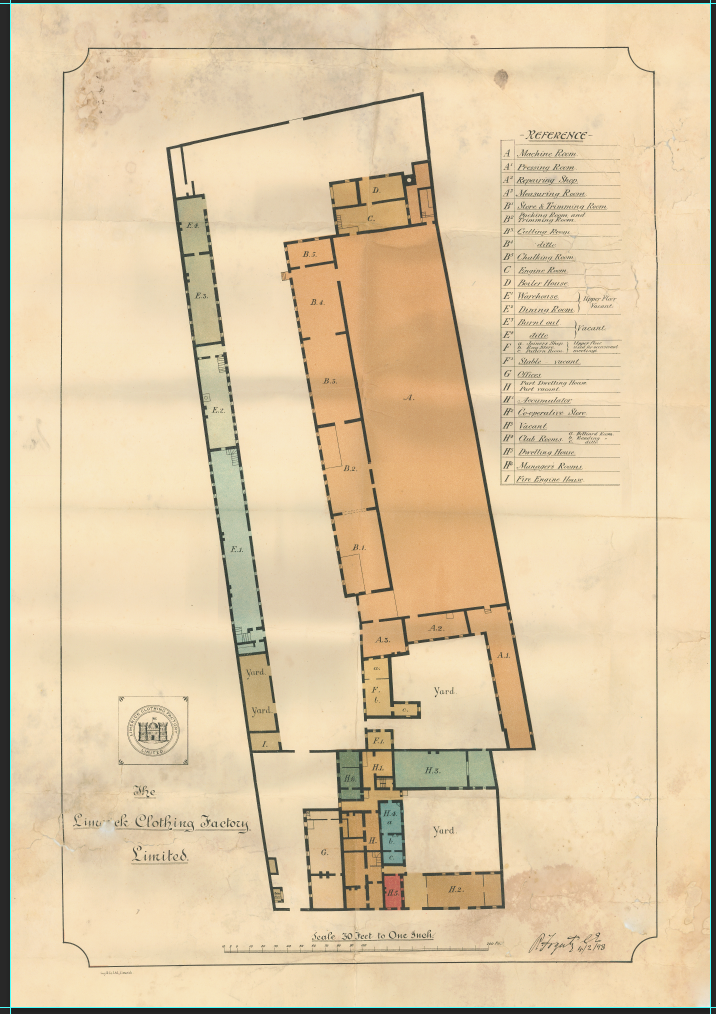
Plan of the Limerick Clothing Factory Incudes a plan of P. Fogarty with a legend identifying each room by alphabetical notation (Machine Room, Pressing Room, Repairing Shop, Measuring Room, Packing Room, Store and Trimming Room, Chalking Room, Engine Room, Boiler House, Warehouse, Dining Room, Club Rooms, Dwelling House, Managers Rooms, Fire Engine House. (fragile) 20 x 30 inches
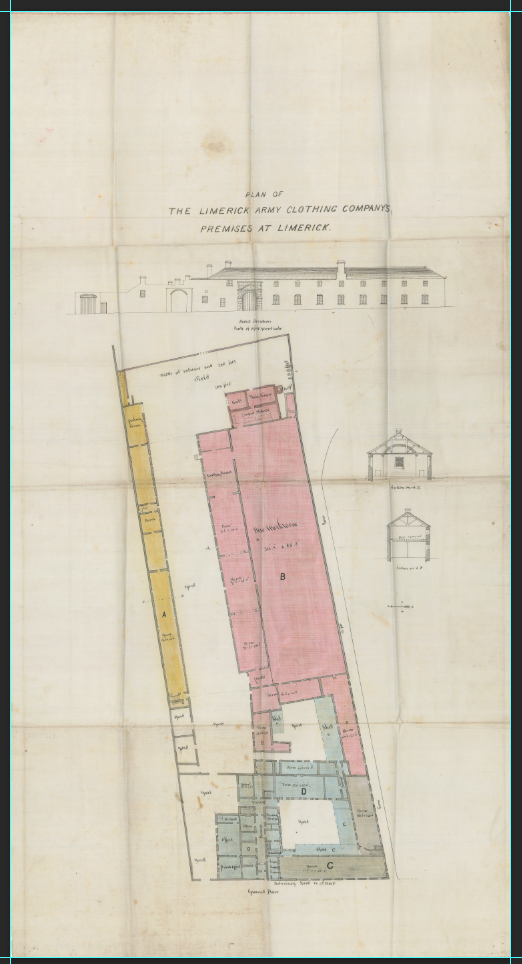
Ground Plan of the Limerick Army Clothing Factory at Limerick on wax paper; includes a sketch of the front elevation and two sections. Scale: 16 feet to 1 inch. 20 x 30 inches
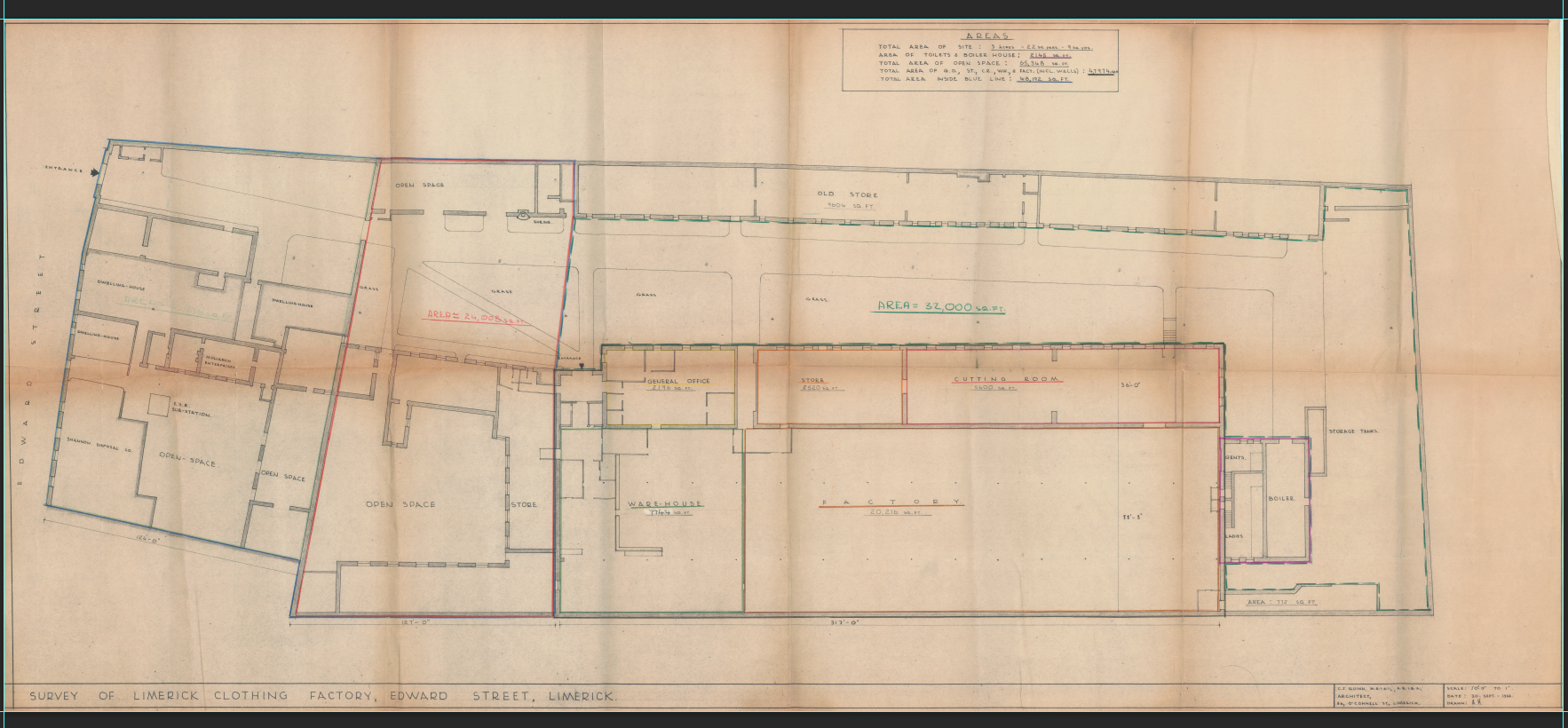
Survey of Limerick Clothing Factory, Lord Edward Street, by C.J. Quinn, Architects, 86 O’ Connell Street, Limerick, Scale 16: 1 Total Area of Site 3 Acres 22 square perches 9 square yards.